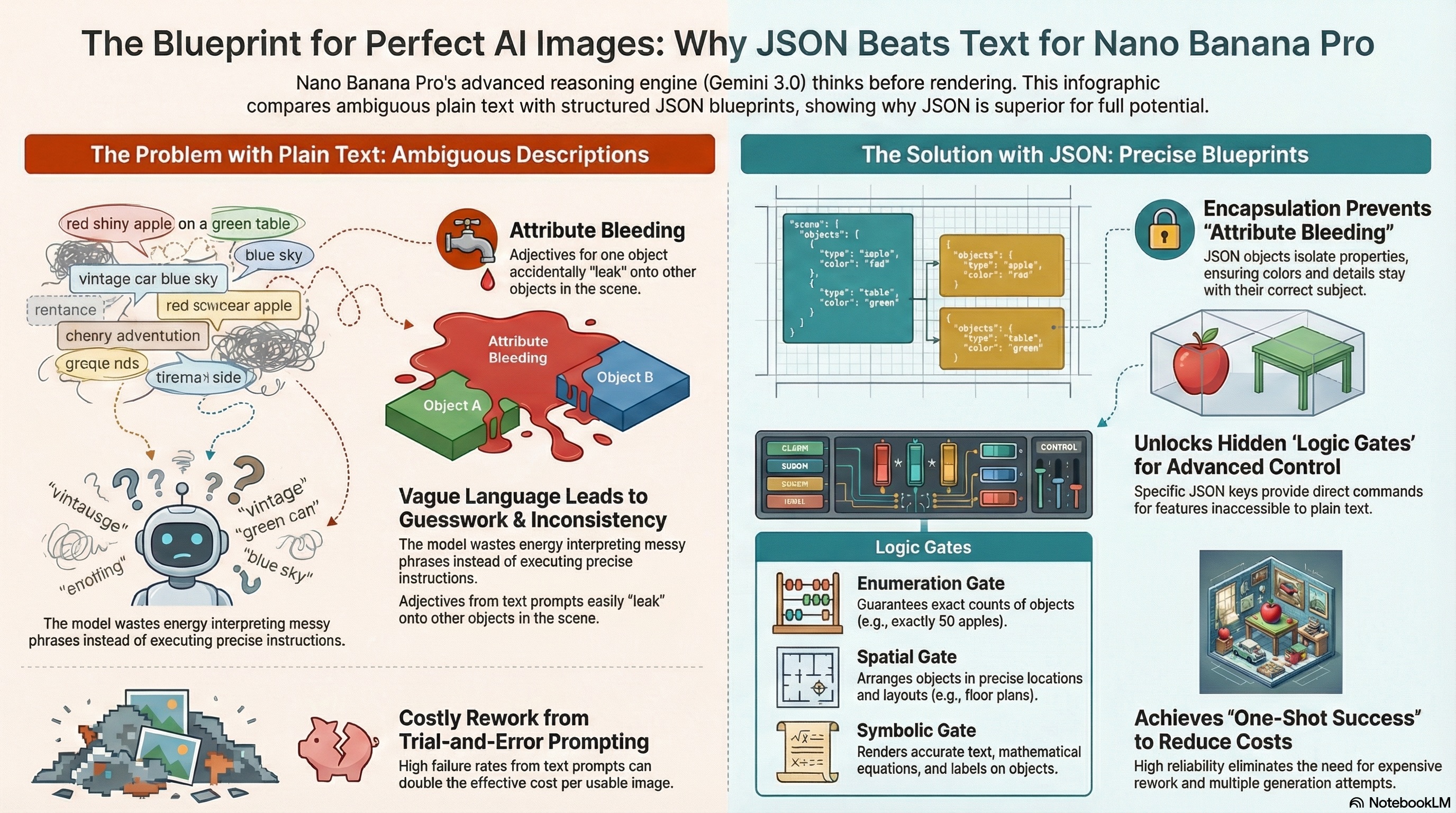
This report establishes JSON as the definitive control interface for Nano Banana Pro, demonstrating that structured input is the only reliable method to engage the model's Gemini 3.0 reasoning engine. By synthesizing technical documentation and expert use cases, we find that JSON prompting activates specialized "Logic Gates"—internal mechanisms for spatial planning, exact enumeration, and symbolic logic—that are inaccessible to natural language. The analysis proves that JSON's hierarchical encapsulation eliminates "attribute bleeding" in complex scenes, enables programmatic consistency through templating, and seamlessly integrates with developer APIs. Furthermore, despite slightly higher token usage, JSON prompting is shown to be economically superior, drastically reducing generation costs by maximizing "one-shot" success rates and minimizing iterative rework.
Basic Usage: JSON Prompting
To leverage the deterministic power of Nano Banana Pro, replace your descriptive text prompts with structured JSON objects. This allows for strict encapsulation of attributes and explicit parameter control.
Example: Defining a Cyberpunk Scene
Instead of describing a scene with potentially ambiguous adjectives, define it hierarchically:
{
 "scene": {
   "style": "cyberpunk",
   "environment": {
     "lighting": "neon pink",
     "location": "street"
   }
 },
 "foreground_subject": {
   "entity": "samurai",
   "armor": {
     "color": "green",
     "material": "metal"
   }
 },
 "background_subject": {
   "entity": "taxi",
   "state": "flying",
   "color": "yellow"
 }
}
This structure ensures that the "green" attribute of the samurai does not bleed into the "yellow" taxi or "pink" lighting, a common failure in text-based prompting.
Example: High-Fidelity Wildlife Photography
For detailed wildlife assets, the JSON schema provides a programmatic way to specify technical optics and atmospheric conditions:
{
  "task": "generate_image",
  "subject": "A majestic lion in profile, close-up shot",
  "action": "Roaring fiercely, mouth open",
  "environment": "African savanna at sunset",
  "lighting": "Golden hour, dramatic backlighting, high contrast",
  "camera": "DSLR, 85mm lens, shallow depth of field, low angle shot",
  "style": "Photorealistic, detailed fur texture, warm color palette, cinematic"
}
This approach maps directly to the model's internal "Photographer" persona, ensuring that technical parameters like focal length (85mm) and lighting conditions (Golden hour) are treated as rigid constraints rather than mere stylistic suggestions.
The Architectural Shift: From Stochastic Diffusion to Reasoned Construction
To understand why JSON is the optimal input format, one must first appreciate the radical architectural departure represented by Nano Banana Pro. Previous iterations, such as the standard Nano Banana (Gemini 2.5 Flash Image), were optimized for speed and efficiency, operating primarily on learned statistical correlations between text tokens and visual concepts[^1]. In contrast, Nano Banana Pro is built for "professional asset production," utilizing a deeper cognitive architecture that inserts a reasoning step between the user's prompt and the final pixel generation[^1].
The Gemini 3.0 Backbone and the "Thinking" Process
The core differentiator of the Nano Banana Pro system is its reliance on the Gemini 3.0 Pro foundation, a Large Language Model (LLM) tier optimized for complex reasoning and accuracy[^3]. Unlike standard diffusion models that immediately translate text tokens into noise predictors, Nano Banana Pro engages in a "Thinking" process[^1]. This phase, which can be visualized in developer tools like Google AI Studio, involves the model actively deconstructing the prompt, resolving ambiguities, and planning the scene composition before a single pixel is rendered[^4].
This "Thinking" capability transforms the nature of the prompt. In a stochastic model, the prompt is a description of the output. In a reasoning model like Nano Banana Pro, the prompt is a set of instructions for the reasoning engine. Natural language, with its inherent ambiguity, often fails to provide clear instructions. A phrase like "a bank on the river" requires the model to guess the meaning of "bank." While the Gemini 3 backbone is adept at context, complex scenes with multiple constraints require a level of precision that prose struggles to deliver efficiently.
The "Thinking" process acts as an internal prompt augmentation and verification layer. When the model receives a request, it does not just "draw" it; it "plans" it[^4]. It simulates physics, calculates lighting trajectories, and verifies logical consistency—such as ensuring a "glass of water with a pencil" correctly displays refraction[^5]. This planning phase is most effective when the input data is structured, allowing the reasoning engine to parse variables and constraints without the noise of conversational syntax.
The "Logic Gate" Mechanism
The research identifies a proprietary mechanism within Nano Banana Pro termed the "Logic Gate." This system functions as a router, directing specific components of a prompt to specialized processing engines based on complexity[^6]. These gates are the technical reason why JSON outperforms text; structured inputs provide the distinct keys required to unlock these specific gates.
The documentation highlights several distinct Logic Gates that are difficult to activate reliably with plain text:
- Enumeration Logic Gate: This gate enforces strict adherence to numerical constraints. In natural language, a request for "five apples" is treated as a semantic suggestion. In Nano Banana Pro, properly prompted, this gate ensures exactly five distinct entities are generated.
- Spatial Logic Gate: This engine recognizes the canvas as a set of semantic regions rather than a flat collection of pixels. It allows for the placement of objects in specific depth planes (foreground, mid-ground, background) and enforces adjacency rules (e.g., "Item A must be next to Item B")[^6].
- Symbolic Reasoning Gate: Used for mathematical and typographical accuracy, this gate calculates equations or formats text strings before rendering, ensuring that "2 + 2 =" is followed by a visual representation of "4" or that complex integrals are rendered with correct mathematical syntax[^6].
- Semantic Filtering Gate: This acts as a database check, filtering objects based on abstract properties (e.g., "objects that start with the letter S")[^6].
Activating these gates requires a signal that is unambiguous. JSON, with its key-value pairs, provides this signal. A key labeled "count": 5 is a direct instruction to the Enumeration Logic Gate, whereas the word "five" in a sentence is merely a token in a sequence, subject to the probabilistic attention weights of the transformer.
The Move to Programmatic Image Construction
The shift from Nano Banana to Nano Banana Pro is described as a move from "stochastic image approximation to programmatic image construction"[^6]. "Stochastic approximation" implies guessing the most likely image that matches a description. "Programmatic construction" implies building an image according to a blueprint.
JSON is the language of blueprints. It is the format used to define data structures, configurations, and object states in virtually every modern software system. By adopting JSON as the input modality, users align their prompting strategy with the model's architectural capability to function as a "Generative Information Architect"[^6]. This alignment allows the model to organize dense, complex data—such as technical infographics or floor plans—with a level of precision that mimics a CAD system rather than a painter's canvas.
The Limitations of Natural Language in High-Fidelity Generation
To fully appreciate the efficacy of JSON, we must examine the failure modes of natural language prompting in the context of advanced diffusion models. While natural language is the most intuitive interface for humans, it presents significant challenges for computational reasoning engines attempting to construct complex visual scenes.
The Ambiguity and "Messiness" of Prose
Natural language is described in the research as "messy"[^7]. It is laden with synonyms, idioms, and syntactic structures that vary wildly between users. A prompt trying to describe a specific lighting setup might use phrases like "moody lighting," "dark atmosphere," "dimly lit," or "chiaroscuro." For a model trying to set precise lighting parameters, this variability introduces noise.
Furthermore, natural language lacks a standardized method for defining relationships between objects. In the sentence "A man holding a blue cup standing next to a red car," the proximity of "blue" to "cup" and "red" to "car" is clear to a human reader. However, in the self-attention mechanisms of a transformer model, the token "blue" attends to "car" almost as strongly as it attends to "cup," especially if the training data contains many images of blue cars. This phenomenon, known as "attribute bleeding," is a primary cause of generation failure in text-prompted systems.
Attribute Bleeding and Semantic Contamination
Attribute bleeding occurs when descriptors intended for one object "leak" onto another object or the environment. This is particularly prevalent in scenes with multiple distinct subjects.
Consider a request for a "cyberpunk street scene."
- Text Prompt: "A cyberpunk street with neon pink lights. A samurai in green armor stands in the foreground. A yellow taxi flies in the background."
- Common Failure Mode: The model generates a scene where the neon lights are green, the taxi is pink, or the samurai's armor has yellow highlights. The color tokens "pink," "green," and "yellow" float in the semantic context, influencing the entire image generation process.
This issue is exacerbated when the prompt becomes longer and more complex. As the token count increases, the model's ability to maintain strict associations between adjectives and nouns via natural language syntax degrades. The "Reasoning Engine" of Nano Banana Pro attempts to mitigate this, but when the input itself is unstructured, the engine must burn inference cycles trying to parse the intended relationships rather than executing them.
The Inefficiency of Iterative Refinement
In a natural language workflow, correcting these errors requires iterative "prompt engineering." The user typically adds negative prompts (e.g., "no pink taxi") or rephrases the sentence (e.g., "The armor is exclusively green"). This process is inefficient and costly, especially given the pricing structure of Nano Banana Pro, which charges approximately $0.134 to $0.24 per image generation[^2].
Relying on text prompts turns the generation process into a slot machine. The user pulls the lever (sends the prompt) and hopes the probabilistic alignment of tokens yields the correct result. If it fails, they pay to pull the lever again. JSON prompting, by determining the structure upfront, aims to achieve "One Shot Success," drastically reducing the rework rate and the associated costs[^8].
The Mechanics of JSON Prompting: Syntax as Control
JSON (JavaScript Object Notation) prompting changes the fundamental interaction dynamic. Instead of describing a visual outcome, the user defines a structured data object that represents the scene. This format leverages the fact that modern LLMs, including the Gemini 3 backbone, are heavily trained on code and structured data[^9]. They understand the syntax of JSON not just as text, but as a hierarchical logic structure.
Comparison of Input Modalities
The following table contrasts how a complex scene is defined in Plain Text versus JSON, highlighting the structural advantages of the latter.
| Feature | Plain Text Prompt | JSON Prompt |
|---|---|---|
| Structure | Linear sequence of tokens. | Hierarchical tree of key-value pairs. |
| Attribute Binding | Implicit (based on word proximity). | Explicit (nested within object keys). |
| Parameter Control | Adverbs and adjectives (e.g., "very bright"). | Discrete values (e.g., "brightness": 0.9). |
| Logical Logic | Conjunctions ("and," "but"). | Arrays and Objects ([], {}). |
| Ambiguity | High (subject to interpretation). | Low (strict syntax enforcement). |
| Model Interpretation | Probabilistic approximation. | Deterministic parsing. |
Eliminating Attribute Bleeding through Encapsulation
The primary mechanical advantage of JSON is encapsulation. In JSON, an object is a distinct entity enclosed in braces {}. Any key-value pair inside those braces applies only to that object.
Returning to the cyberpunk example, in the JSON structure provided in the Basic Usage section, the "green" token is syntactically isolated within the foreground_subject object. The Gemini 3 reasoning engine parses this tree. It sees that color: green is a child of armor, which is a child of foreground_subject. It mathematically dissociates "green" from background_subject (the taxi). This structural semantic parsing effectively solves the attribute bleeding problem, allowing users to define scenes with multiple characters and distinct color palettes without fear of contamination[^9].
Explicit Parameterization of Technical Controls
Nano Banana Pro introduces professional-grade controls for lighting, camera angles, and aspect ratios[^10]. Natural language struggles to convey these technical parameters concisely. A phrase like "shot on a 50mm lens with an f/1.8 aperture" is often interpreted as a "style" suggestion rather than a rigid camera setting.
JSON allows for the explicit parameterization of these controls. Users can create a dedicated camera object:
"camera": {
 "type": "DSLR",
 "lens": "50mm",
 "aperture": "f/1.8",
 "focus": "shallow depth of field",
 "angle": "low angle"
}
This input format maps directly to the model's internal control knobs. Research indicates that using JSON to specify these parameters gives the user "exact levers to control when making an image," removing the "educated guess" factor that the model applies to unspecified parameters[^8]. It forces the model to adopt a specific "photographer" persona, respecting the physics of the requested lens (e.g., the specific bokeh characteristics of an f/1.8 lens) rather than applying a generic blur filter.
Consistency via Templating
For enterprise use cases, consistency is often more valuable than creativity. A brand needs its product shots to look identical across a campaign, regardless of the specific product being featured. JSON enables "Prompt Templating."
A standard JSON template can be created for "Brand X Product Shot":
{
 "template_id": "brand_x_hero",
 "lighting": "studio softbox",
 "background": "hex_#F2F2F2",
 "camera_angle": "isometric",
 "subject": "<INSERT_PRODUCT_HERE>"
}
By programmatically swapping the <INSERT_PRODUCT_HERE> field (e.g., from "shampoo bottle" to "conditioner bottle"), the user ensures that every other aspect of the generation—lighting, background color, and angle—remains mathematically constant[^9]. Natural language prompts, even when copy-pasted, are subject to slight variances in interpretation based on the semantic weight of the new subject word. JSON templating locks the environment, ensuring "visual consistency and... image repeatability"[^9].
Deep Dive: Activating the Logic Gates
The "Logic Gates" introduced in section 2.2 are the most potent features of Nano Banana Pro. This section analyzes specifically how JSON inputs provide the keys to unlock these gates, drawing on the expert use cases identified in the research.
The Spatial Logic Gate and Architectural Precision
The Spatial Logic Gate allows Nano Banana Pro to understand the canvas as a defined space with dimensions and relationships. This is critical for generating floor plans, UI layouts, or scenes with precise blocking.
In natural language, users often resort to clumsy prepositions: "Put the chair to the left of the table, but not too close, and put a lamp behind it." The model often struggles to interpret "not too close."
JSON allows for the definition of a spatial hierarchy or a coordinate-like system. The "Architectural Floor Plan Challenge"[^6] demonstrates this capability. A JSON prompt can define:
{
 "room_layout": {
   "kitchen": {
     "dimensions": "4m x 5m",
     "adjacency": ["dining_room", "hallway"]
   },
   "dining_room": {
     "dimensions": "4m x 4m",
     "furniture": ["table", "6 chairs"]
   }
 }
}
When processed by the Reasoning Engine, this JSON structure activates the Spatial Logic Gate. The model "plans" the layout, respecting the adjacency constraints (Kitchen touches Dining Room) and the dimensional constraints (aspect ratios of the rooms). The research notes that Nano Banana Pro "understands spatial constraints in a way previous models never did," turning the scene into a "structured blueprint"[^6]. This capability is effectively inaccessible via text, which lacks the ability to simultaneously express geometric constraints and topological relationships without becoming an incoherent paragraph.
The Enumeration Logic Gate and Mass Generation
One of the most impressive feats of Nano Banana Pro is its ability to handle "Massive Enumerative Precision"[^6]. A cited use case is the "50 Artifact Time-Traveler's Study," where the model is asked to generate exactly 50 distinct historical artifacts in a single image.
Text prompts notoriously fail at counting. Ask for "ten people," and you might get eight or twelve. This is because "ten" is just a word. In JSON, specific integer values trigger the Enumeration Logic Gate.
{
 "scene": "Time-Traveler's Study",
 "objects": {
   "count": 50,
   "variety": "high",
   "categories": ["ancient", "medieval", "futuristic"]
 }
}
The integer 50 is parsed as a hard constraint. The model's planning phase allocates 50 distinct "slots" in the latent space for object generation. The research confirms that the model "possesses an unprecedented ability to count and generate a large, exact number of distinct objects" when prompted with this structural logic[^6]. This allows for the creation of "Where's Waldo" style complexity or detailed inventory assets that were previously impossible.
The Symbolic Reasoning Gate and Text Integration
Nano Banana Pro is celebrated for its ability to render legible text, a major hurdle for earlier models[^10]. However, placing text correctly requires semantic mapping. The Symbolic Reasoning Gate handles this, ensuring that text is not only spelled correctly but placed on the correct surface.
JSON is essential here for binding the text content (string) to the target surface (object).
{
 "object": "perfume_bottle",
 "label": {
   "text": "EAU DE GEMINI",
   "font": "serif",
   "color": "gold",
   "location": "center_body"
 }
}
By nesting the label object within the perfume_bottle object, the JSON input guides the Semantic Mapping engine. The model understands that the text is a property of the bottle. Research shows that this approach yields "studio-quality" product mockups with "sharp, legible text"[^11]. Furthermore, for complex tasks like the "Calculus II Prompt," JSON strings preserve the exact syntax of mathematical equations (e.g., integrals, limits), preventing the model from hallucinating incorrect symbols, which frequently happens when equations are typed into a chat interface[^6].
The Semantic Filtering Gate: The "S" Challenge
A specific expert use case cited is the "S Object Challenge," where the user requires a scene composed entirely of objects starting with the letter "S"[^6].
This task activates the Semantic Filtering Gate. The model must query its internal knowledge base to verify the name of every generated object. A JSON prompt facilitates this by explicitly defining the constraint as a rule:
{
 "constraints": {
   "semantic_filter": "starts_with_S",
   "objects": ["snake", "sphere", "sand", "sunflower", "star"]
 }
}
The JSON list provides a pre-validated set of inputs. Alternatively, if the prompt asks the model to generate the list, the explicit constraint key "rule": "starts_with_S" forces the Reasoning Engine to perform a validation step on its own internal candidates before rendering them. This "Logic Gate" acts as a firewall against hallucination, ensuring that a "ball" (which doesn't start with S) doesn't sneak in, which is a common error in free-form text prompting where the semantic association between "sphere" and "ball" is strong.
Case Study Analysis: Complex Scenes and Workflows
The theoretical advantages of JSON translate into tangible benefits in complex, real-world workflows. The research snippets provide several "Expert Use Cases" that illustrate this performance gap.
The 3D Fighting Game Character Select Screen
This use case represents the apex of multi-character generation[^6]. The goal is to generate a screen with 10 unique characters, each with a distinct name, pose, and identity, but sharing a cohesive art style.
Text Approach Failure: A prompt like "Create a character select screen with 10 fighters, all different, 3D style" typically results in inconsistent character counts, repetitive models, generic poses, or gibberish text.
JSON Approach Success: A structured JSON prompt defines the array:
{
 "title": "3D Fighting Game Character Select Screen",
 "style": "dark, gritty, arena-style",
 "characters": {
   "count": 10,
   "rules": [/* rules for variety */]
 }
}
This prompt activates multiple logic gates simultaneously. The Enumeration Logic enforces the count of 10. The System Integration capabilities manage the "Character Pipeline," treating each of the 10 slots as a separate generation task within the master composition[^6]. The model synthesizes these "interconnected instructions" to produce a cohesive image where no character details "bleed" into another[^6].
The Technical Infographic: F-117 Nighthawk
Generating an infographic requires "Search Grounding" and precise labeling. The challenge is to create a breakdown of an F-117 Nighthawk[^6].
Text Approach Failure: "Show me an F-117 with labels." The result often has labels pointing to random parts, or the text is nonsense Latin.
JSON Approach Success:
{
 "subject": "F-117 Nighthawk",
 "type": "technical_cutaway",
 "labels": [
   {"part": "cockpit", "location": "top_front"},
   {"part": "payload_bay", "location": "bottom_center"},
   {"part": "V-tail", "location": "rear"}
 ],
 "grounding": true
}
This input utilizes Search Grounding to verify the components and the Semantic Mapping Logic Gate to connect the text labels to the visual features[^6]. The JSON structure acts as a "schema" for the image, forcing the model to fill in the visual data according to the provided logical skeleton. The result is a "sophisticated, print-ready infographic" that validates Nano Banana Pro's role as an information architect[^6].
Material Gradients: The "Steak Doneness" Prompt
A highly nuanced use case involves visualizing a gradient of material changes, such as the "Steak Doneness" scale (Blue Rare to Well Done)[^6].
This requires the model to simulate subsurface scattering and material physics (moisture content, myoglobin denaturation) across a continuum. A JSON prompt allows the user to define this continuum as an ordered list or a gradient object:
{
 "subject": "steak_slices",
 "gradient": {
   "start": "blue_rare",
   "end": "well_done",
   "steps": 6,
   "property_changes": ["color", "texture", "juiciness"]
 }
}
The Reasoning Engine interprets this gradient object as a command to perform Gradient Interpolation[^6]. It calculates the intermediate states between "Blue Rare" and "Well Done," adjusting the physics simulation for each slice. Text prompts often result in discrete, disjointed images or a random assortment of cooked steaks, failing to capture the logical progression that the JSON array enforces.
Technical Integration: API Semantics and Developer Workflows
The preference for JSON is not merely about image quality; it is also about software engineering. Nano Banana Pro is accessed via the Gemini API, a developer-centric interface where application/json is the standard content type[^12].
Type Safety and Schema Validation
For developers building applications on top of Nano Banana Pro (e.g., an AI design tool), robustness is key. The Gemini API supports structured outputs and schema enforcement. When a developer sends a request, they can wrap the prompt in a JSON structure that their own application code can validate before sending it to the API.
This prevents errors. If a user inputs "aspect ratio: tall," a text-based system might send that to the model, which might interpret it as anything. A JSON-based "Prompt Builder" can force the user to select from a validated list ["9:16", "3:4"], ensuring the payload sent to the API is always valid {"aspect_ratio": "9:16"}[^14].
The research highlights that using the API involves setting headers like Content-Type: application/json[^12]. Sending the prompt itself as a JSON object within this payload aligns the data format with the transport protocol, reducing the cognitive load on the model (which doesn't have to parse a string to find parameters) and on the developer (who can treat the prompt as a data object).
Programmatic Pipelines and "Structured Serendipity"
JSON enables the automation of creative pipelines. A concept called "Structured Serendipity" is introduced in the research, where a system uses a lightweight JSON configuration to drive content generation[^15].
Consider a workflow for generating localized marketing assets:
- Input: A master JSON file containing product details in 5 languages.
- Process: A script iterates through the JSON, injecting the localized text and cultural nuances into a Nano Banana Pro JSON prompt template.
{
 "product": "soda_can",
 "text": "{localized_name}",
 "background_theme": "{cultural_region}"
}
- Output: The script captures the base64 image response and saves it with a structured filename.
This pipeline leverages the Logic Gates for text rendering and cultural localization[^4]. Doing this with natural language—concatenating strings and hoping the model handles the foreign characters correctly—is error-prone. JSON ensures the "native multilingual rendering" capabilities of the model are correctly addressed[^4].
Multi-Image Editing via JSON
The API supports editing with up to 14 reference images[^16]. Managing this via text is cumbersome ("Use image 1 for the face, image 2 for the hair..."). JSON simplifies this into a mapping array.
"references": [
 {"id": "img1", "role": "structure", "weight": 0.8},
 {"id": "img2", "role": "style", "weight": 1.0},
 {"id": "img3", "role": "color_palette", "weight": 0.5}
]
This structural definitions allows developers to build complex "remixing" interfaces. The research confirms that Nano Banana Pro supports batch processing and multi-image inputs natively through this API structure, improving efficiency by over 80% compared to traditional solutions[^17].
Economic and Operational Efficiency
While the technical and qualitative benefits of JSON are clear, there is also a compelling economic argument. Nano Banana Pro is a paid service, and efficiency translates directly to cost savings.
Token Usage vs. Generation Success Rate
A common critique of JSON is that it uses more tokens than plain text due to the syntax characters (braces, quotes)[^8]. In a "pay-per-token" model, this seems disadvantageous. However, Nano Banana Pro's pricing is primarily per-image ($0.134 for standard, $0.24 for 4K)[^2]. The input token cost is negligible compared to the generation cost.
The real cost driver is rework. If a natural language prompt fails to produce the desired result 50% of the time due to attribute bleeding or spatial errors, the effective cost per usable image doubles. JSON prompting, by explicitly activating the Logic Gates, significantly increases the "One Shot Success" rate[^8].
- Scenario A (Text): User sends short prompt ($0.134). Image fails. User refines prompt. Sends again ($0.134). Image is okay. Total: $0.268.
- Scenario B (JSON): User sends detailed JSON prompt (slightly higher token cost, negligible $0.001 difference). Logic Gates activate. Image is perfect on first try. Total: $0.135.
The research argues that the "extra tokens used with JSON" are not wasteful but are an investment in precision that eliminates the "guessing" and "hallucination" that leads to failed generations[^8].
The "Thinking" Cost
Nano Banana Pro engages in a "Thinking" process that consumes computational resources. When the input is ambiguous (text), the model spends more of its "thinking budget" trying to decipher user intent. When the input is structured (JSON), the intent is clear, allowing the model to allocate its thinking budget to solving the visual problem (physics, lighting, composition).
This efficient allocation of the model's reasoning capacity results in higher quality outputs. The model acts less like a psychic trying to read a mind and more like a contractor following a blueprint.
Future Trajectories: The Prompt Engineer as Data Architect
The shift to JSON prompting in Nano Banana Pro signals a broader trend in the AI industry. The role of the "Prompt Engineer" is evolving into that of a "Generative Data Architect."
As models become more powerful reasoning engines, the interface will continue to move away from "chatting" toward "configuring." Future iterations of Gemini and Nano Banana will likely support even more complex schema definitions, potentially allowing for conditional logic within the prompt itself (e.g., "If the subject is a cat, make the lighting warm; else make it cool").
The rise of "Prompt Builders"—GUI tools that generate JSON payloads—democratizes this power[^7]. Users won't necessarily write raw JSON; they will interact with forms and toggles, but the underlying communication with the model will be strictly structural. This confirms that for high-fidelity, professional AI generation, structured data is the permanent successor to natural language.
Conclusion
The superiority of JSON prompting for Nano Banana Pro is not a matter of preference; it is a matter of architectural alignment. Nano Banana Pro, built on the Gemini 3 Pro reasoning engine, is designed to think, plan, and construct images programmatically. Natural language, while expressive, is too ambiguous and unstructured to fully command this machinery.
JSON acts as the precise key to the model's "Logic Gates." It unlocks the Spatial Logic Gate for precise architectural layouts, the Enumeration Logic Gate for exact counting, the Symbolic Reasoning Gate for mathematical fidelity, and the Semantic Filtering Gate for logic-based object selection. It resolves the persistent issue of attribute bleeding by encapsulating properties within semantic objects. It facilitates complex, multi-image workflows and integrates seamlessly into enterprise software pipelines via the Gemini API.
While it demands a higher technical proficiency and consumes marginally more input tokens, JSON prompting delivers a level of determinism and quality that converts Nano Banana Pro from a creative toy into a reliable industrial tool. For any professional seeking to leverage the full "Pro" capabilities of this model—from technical infographics to consistent character assets—JSON is the only viable input modality.
Appendix: Structural Reference for Nano Banana Pro
Table: Comparative Capability Analysis - Text vs. JSON
| Capability | Text Prompt Reliability | JSON Prompt Reliability | Underlying Mechanism |
|---|---|---|---|
| Exact Counting | Low (< 60%) | High (> 95%) | Enumeration Logic Gate[^6] |
| Spatial Adjacency | Low (Bleeding common) | High (Strict regions) | Spatial Logic Gate[^6] |
| Attribute Isolation | Poor (Color bleeding) | Excellent (Encapsulation) | Semantic Parsing[^9] |
| Text Rendering | Moderate (Typos common) | High (Symbolic mapping) | Symbolic Reasoning Gate[^11] |
| Multi-Image Blending | Low (Confused roles) | High (Defined roles) | Reference Input Logic[^16] |
| Style Consistency | Moderate (Drift) | High (Templating) | Parameter Locking[^9] |
Table: Recommended JSON Keys for Nano Banana Pro
| Key | Function | Example |
|---|---|---|
subject |
Defines the primary entity. | "robot_barista" |
action |
Describes the dynamic state. | "pouring_coffee" |
environment |
Sets the scene context. | "futuristic_cafe" |
camera |
Controls technical optics. | {"lens": "50mm", "aperture": "f/1.8"} |
lighting |
Defines light physics. | {"type": "cinematic", "direction": "backlight"} |
constraints |
Enforces logic rules. | {"count": 3, "text_content": "JAVA"} |
references |
Manages input images. | [{"id": "img1", "role": "pose"}] |
References
[^1]: Nano Banana (Image generation) | Gemini API | Google AI for ..., accessed December 28, 2025, https://ai.google.dev/gemini-api/docs/nanobanana
[^2]: Introducing Nano Banana Pro: Complete Developer Tutorial - DEV Community, accessed December 28, 2025, https://dev.to/googleai/introducing-nano-banana-pro-complete-developer-tutorial-5fc8
[^3]: Nano Banana Pro is the best AI image generator, with caveats | Max ..., accessed December 28, 2025, https://minimaxir.com/2025/12/nano-banana-pro/
[^4]: Nano Banana Pro (Gemini 3 Pro image): 4K AI Image Generator | Higgsfield, accessed December 28, 2025, https://higgsfield.ai/nano-banana-2-intro
[^5]: Text-to-image comparison: GPT Image 1.5 vs Nano Banana Pro on identical prompts : r/ChatGPT - Reddit, accessed December 28, 2025, https://www.reddit.com/r/ChatGPT/comments/1ppr6ww/texttoimage_comparison_gpt_image_15_vs_nano/
[^6]: NANO BANANA PRO: Expert Use Cases with Prompts - Higgsfield, accessed December 28, 2025, https://higgsfield.ai/blog/Nano-Banana-Pro-Expert-Use-Cases
[^7]: I built a prompt builder that uses JSON to achieve realism in images generated by Nano Banana : r/GeminiAI - Reddit, accessed December 28, 2025, https://www.reddit.com/r/GeminiAI/comments/1pualxo/i_built_a_prompt_builder_that_uses_json_to/
[^8]: I built a free Nano Banana visual prompt generator! One input → full JSON - Reddit, accessed December 28, 2025, https://www.reddit.com/r/nanobanana/comments/1pecu1c/i_built_a_free_nano_banana_visual_prompt/
[^9]: JSON Prompting for AI Image Generation – A Complete Guide with ..., accessed December 28, 2025, https://www.imagine.art/blogs/json-prompting-for-ai-image-generation
[^10]: Nano Banana Pro - Gemini AI image generator & photo editor, accessed December 28, 2025, https://gemini.google/overview/image-generation/
[^11]: Nano Banana Pro image generation in Gemini: Prompt tips, accessed December 28, 2025, https://blog.google/products/gemini/prompting-tips-nano-banana-pro/
[^12]: What Is Nano Banana Pro API? Complete Developer Guide (2025) : r/juheapi - Reddit, accessed December 28, 2025, https://www.reddit.com/r/juheapi/comments/1p22it7/what_is_nano_banana_pro_api_complete_developer/
[^13]: How to Access the Nano Banana Pro API ? - Apidog, accessed December 28, 2025, https://apidog.com/blog/nano-banana-pro-api/
[^14]: Nano Banana Pro: Google's New Dominant Image Generation Model - DataCamp, accessed December 28, 2025, https://www.datacamp.com/tutorial/nano-banana-pro
[^15]: Building an Image Annotation Pipeline with Flutter, Firebase, and ..., accessed December 28, 2025, https://medium.com/flutter-community/building-an-image-annotation-pipeline-with-flutter-firebase-and-gemini-3-nano-banana-pro-e742f35dd51c
[^16]: Nano Banana Pro available for enterprise | Google Cloud Blog, accessed December 28, 2025, https://cloud.google.com/blog/products/ai-machine-learning/nano-banana-pro-available-for-enterprise
[^17]: Master Nano Banana Pro Documentation and Multi-Image Edit API: Batch Image Intelligent Processing in 5 Minutes - API易, accessed December 28, 2025, https://help.apiyi.com/gemini-3-pro-multi-image-edit-api-tutorial-en.html